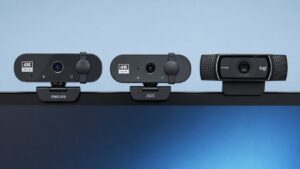
I compared these three webcams around the things that actually matter in daily use: image quality, autofocus, lighting, microphone quality, and whether the extra features are genuinely useful or just look good on the spec sheet.
Disclosure: As an Amazon Associate, I earn from qualifying purchases.
Here’s the short version.
The Flip600S 4K Webcam is the one I’d pick for most people. It has 4K video, PDAF autofocus, automatic light correction, noise-canceling microphones, a privacy cover, and even comes with a tripod. It feels like the most complete package without being overly focused on one specific use case.
The EMEET S600L makes more sense if streaming or content creation is the priority. Its built-in ring light is genuinely useful if your desk setup doesn’t already have good lighting.
The EMEET NOVA 4K is the more straightforward work-focused option. It’s good for Zoom, Teams, and regular meetings, although it doesn’t have as many standout features as the other two.
1) Flip600S 4K Webcam
Best overall
The Flip600S has probably the most balanced feature set of the three.
You get 4K at 30fps from a 1/2.55-inch CMOS sensor, but the part I care about more is the PDAF autofocus. Cheap webcams can look perfectly sharp until you move slightly toward or away from the camera, and then they spend a second hunting for focus. Phase detection autofocus should make that much less noticeable.
The 79° field of view is also a good middle ground. It’s wide enough that you don’t feel cropped into the frame, but it shouldn’t show your entire room during a work call.
There’s automatic light correction for darker rooms and built-in noise-canceling microphones, so you don’t necessarily need a separate mic for normal meetings.
I also like that the basic accessories aren’t treated as extras. You get a privacy cover, a standard 1/4-inch tripod mount, and a tripod in the box. The camera can rotate horizontally and tilt vertically, which gives you a lot more freedom with placement than a basic monitor-mounted webcam.
It’s plug-and-play over USB and works with Windows, macOS, and Linux, along with the usual apps like Zoom, Google Meet, Skype, and Teams.
Pros
- Sharp 4K video at 30fps
- PDAF autofocus
- 1/2.55-inch CMOS sensor
- Automatic light correction
- Noise-canceling microphones
- 79° field of view
- Privacy cover
- Tripod included
- Flexible mounting and positioning
- Plug-and-play setup
Cons
- 4K is limited to 30fps
- 79° FOV is fixed, so there’s no option to switch between narrow and wide framing
Who it’s for
Remote workers, students, streamers, and anyone who wants a good all-around webcam without having to add a bunch of accessories afterward.
[Check the Flip600S 4K Webcam on Amazon]
2) EMEET S600L 4K Webcam
Best for streaming
The S600L feels much more specifically designed for people who spend a lot of time on camera.
The big difference is the built-in ring light. A lot of webcam comparisons focus entirely on resolution, but lighting can make a bigger difference to how you actually look on camera than going from one 4K webcam to another.
If your desk is in a dark corner or you regularly take calls at night, having lighting built directly around the lens is genuinely convenient.
It also uses a larger sensor and PDAF autofocus, which helps with image quality and focus consistency when lighting conditions aren’t ideal.
For streaming, Discord, YouTube, or regular video calls where you actually care about how you look on camera, the extra lighting gives the S600L a clear reason to consider it over a more conventional webcam.
Pros
- Built-in ring light
- Multiple lighting modes
- Large sensor
- Fast PDAF autofocus
- Good option for streaming
- Useful in rooms with poor lighting
Cons
- The built-in light adds less value if you already have proper desk lighting
- More creator-focused than some people actually need
Who it’s for
Streamers, content creators, and anyone whose room lighting isn’t particularly good.
[Check the EMEET S600L on Amazon]
3) EMEET NOVA 4K Webcam
Best for regular work calls
The NOVA is the more traditional work webcam of the three.
Its 73° field of view is narrower than the Flip600S, which can actually be useful for meetings because less of your room ends up in the frame.
You still get a sharp 4K image, autofocus, dual microphones, and a privacy cover. For Zoom, Teams, or Google Meet, that’s basically everything most people need.
The reason I put it third isn’t that there’s anything particularly wrong with it. It’s just harder to find a feature that makes it stand out.
The Flip600S offers a more complete all-around package, while the S600L has the built-in lighting that gives it a clear advantage for certain setups.
Pros
- Sharp 4K image
- Fast autofocus
- Dual microphones
- Narrower 73° FOV works well for meetings
- Privacy cover
- Simple setup
Cons
- Fewer standout features than the other two
- Less interesting for streaming or content creation
Who it’s for
Remote workers, teachers, consultants, and anyone who mainly needs a webcam for meetings rather than content creation.
Final ranking
1. Flip600S 4K Webcam
The most balanced option here. Good image quality, PDAF autofocus, useful microphones, sensible framing, and more mounting flexibility than I expected.
2. EMEET S600L
The one I’d look at first for streaming or if your desk has poor lighting. The built-in ring light is the feature that separates it from the other two.
3. EMEET NOVA 4K
A solid choice for everyday work calls, but it doesn’t have quite as strong a reason to choose it over the other two.
Which one would I buy?
For general use, I’d probably go with the Flip600S.
It covers basically everything I’d want from a webcam without leaning too heavily into streaming features: 4K video, fast autofocus, automatic light correction, decent built-in audio, a privacy cover, and flexible mounting.
The included tripod is also more useful than it sounds. Being able to put the camera slightly above or beside your monitor can give you a much better angle than being stuck with whatever position the top of your screen allows.
If I were mainly streaming and didn’t already have good lighting, though, I’d take a closer look at the EMEET S600L instead.