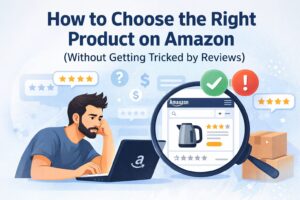
Let’s be honest: shopping on Amazon is basically modern-day treasure hunting. You type something simple like “wireless earbuds,” and suddenly you’re staring at 4,000 options, all “best-selling,” all “top-rated,” all apparently crafted by angels with PhDs in sound engineering.
And then there are the reviews.
Some are helpful. Some are unhinged. Some are… suspiciously poetic for a $12 phone stand.
If you’ve ever bought something with 4.7 stars and then wondered if you got the bargain-bin version of the product, this guide is for you. I’m going to show you how to buy on Amazon in a way that helps you pick the right item without falling for fake-looking Amazon product reviews or inflated ratings.
1) Start with your use case, not the product name
Before you click anything, ask: what problem am I actually trying to solve?
You don’t need “a blender.” You need a blender for protein shakes (easy cleaning matters), or a blender for frozen fruit (power matters), or a blender for soups (heat-safe jar matters).
If you shop by vague category, Amazon will push you toward flashy listings. If you shop by use case, you instantly filter out a ton of junk.
Quick move: write down 3 must-haves and 2 nice-to-haves. This stops you from getting hypnotized by a “10-in-1” product that does 10 things poorly.
2) Don’t trust the star rating alone, trust the review pattern
A 4.6-star average doesn’t automatically mean a product is great. It just means the average reviewer felt “fine” at the moment they clicked five stars.
What you want is the pattern:
Are complaints consistent? Like “battery died after two weeks” repeated over and over? That matters. Are the 5-star reviews weirdly generic (“Good product. Works great.”)? That’s suspicious. Do the 1-star reviews talk about shipping (less relevant) or performance (very relevant)? Big difference.
My rule: read the 3-star reviews first. Three-star people are usually the most honest because they’re not trying to hype it up or burn it down.
3) Filter by most recent reviews and actually read them
Products change. Sellers change. Manufacturers quietly swap parts. A listing with 10,000 reviews might be living off a reputation it earned years ago.
So do this every time:
Sort reviews by “Most recent”
Scan the last 30–90 days
Look for a sudden shift in complaints
If you see phrases like “different than before,” “new version is worse,” or “quality dropped,” take that seriously. That’s one of the fastest ways to avoid buying something that used to be good but isn’t anymore.
4) Use “Verified Purchase” as a filter, not a guarantee
Yes, “Verified Purchase” helps. It means the person actually bought the product on Amazon.
But don’t worship it. People still leave lazy reviews. People still review too early (“Works great!” after 15 minutes). And yes, some stuff still gets gamed.
A better signal is Verified Purchase plus details, photos, or video. Real buyers usually mention specifics: fit, materials, battery life, noise, comfort, durability.
If a review reads like a brochure (“premium quality,” “top-tier,” “highly recommended seller”), that’s not information. That’s vibes.
5) Spot fake reviews by looking for weird timing and repeated language
If you want to spot fake reviews on Amazon, look for unnatural behavior:
A flood of reviews posted within a short window
A bunch of reviewers using the same phrases
Lots of 5-star ratings with zero details
Reviews that praise the seller more than the product
Real people talk like real people: “It fits my dorm desk but the clamp is weak.” “Sound is solid, but the mic is trash on calls.” That’s useful.
Bots and paid reviews sound like they’re pitching you a startup.
6) Read negative reviews for deal-breakers, not drama
I love negative reviews because they’re basically free product testing. The trick is knowing what to ignore.
Ignore the nonsense:
Late delivery complaints (unless the item arrives broken often)
“I didn’t read the description” rage
Color/size confusion when the listing was clear
Focus on deal-breakers:
Safety issues
Frequent breakage
Misleading sizing or measurements
Compatibility problems
Customer service nightmares for returns or warranty
If the same functional failure shows up again and again, believe it. People don’t coordinate identical complaints for fun.
7) Check who is selling it and who is shipping it
This is boring but important.
Look at the seller box:
Ships from: Amazon or a third party?
Sold by: the brand, Amazon, or some random storefront name?
In general, Sold by Amazon or the brand and Fulfilled by Amazon tends to be safer. Returns are easier, support is smoother, and you’re less likely to get weird “not our problem” behavior.
For electronics, skincare, supplements, and expensive items, I’m extra picky here. That’s where you’ll feel the pain the most if something goes wrong.
8) Compare the specs for 60 seconds like a responsible adult
I know, specs aren’t sexy. But this is how you stop overpaying for marketing.
Open 3–5 top options in new tabs and compare the basics: materials, size, power, warranty, compatibility.
Example: power banks
Capacity (mAh)
Output (watts) and fast-charging support
Ports (USB-C matters) and cable included or not
Example: desk chairs
Seat dimensions
Adjustability (armrests, lumbar)
Weight limit and warranty length
When you compare like this, you stop buying “best rated products on Amazon” and start buying the best product for you.
9) Don’t get hypnotized by “Amazon’s Choice” or “Best Seller”
Amazon’s Choice usually means “popular enough, low returns, decent rating, in stock.” It doesn’t automatically mean best.
Best Seller can literally mean “cheap and everyone tried it.” Sometimes that’s fine. Sometimes it’s a trap.
Treat badges as a starting point, not a decision.
10) Use a simple final checklist before you hit Buy
Here’s my quick decision rule:
Buy it if
Recent reviews are consistently positive
3-star reviews mention minor issues you can live with
Negative reviews aren’t about the core function
Seller and returns look safe
User photos match the listing photos
Skip it if
Recent reviews mention a quality drop
Most 5-star reviews are generic and empty
The same failure point shows up repeatedly
Returns look messy or seller looks sketchy
This is how you avoid that classic moment where the product arrives and you instantly think, “Yeah… I’m returning this.”
Final takeaway
Buying on Amazon doesn’t have to feel like gambling. The goal isn’t to find the highest rating. The goal is to find a product that matches your use case, has stable quality in recent reviews, and comes from a seller you can trust.
Follow this Amazon buying guide for five minutes, and you’ll save yourself weeks of annoyance, refunds, and “why did I buy this” regret.