If you’re a student, silence is basically a luxury item. Your roommate decides to become a TikTok DJ, the library has a guy unwrapping snacks like it’s a Marvel movie, and your neighbors are apparently building a spaceship… at 2 a.m.
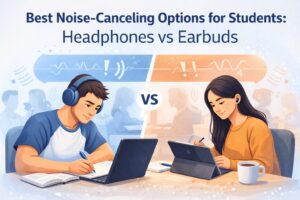
That’s why noise-canceling gear isn’t just “nice to have.” It’s a focus tool. The real question is: what’s better for students—headphones or earbuds? Let’s break it down in a way that actually helps you choose (without the usual “it depends” cop-out).
How noise canceling works (quick and useful)
Most modern devices use active noise canceling (ANC). Small microphones listen to outside sound, and the device plays an “opposite” signal to reduce what you hear.
Two important realities:
- ANC is best at steady, low-frequency noise (AC hum, bus engines, background rumble).
- Sudden noises (someone yelling, dishes clanking) are harder to kill completely, so fit and passive isolation still matter.
Headphones vs earbuds in one sentence
If you want the strongest, most consistent noise blocking and better long-session comfort, pick headphones.
If you want portability, quick daily use, and something you can throw in your pocket, pick earbuds.
Now the details.
1) Noise-canceling strength: who wins?
Over-ear headphones
They usually win because:
- the ear cups seal around your ear
- there’s more space for microphones and processing
- they naturally block more sound even before ANC kicks in
Result: stronger and more reliable noise reduction in dorms, cafeterias, buses, and noisy libraries.
Earbuds
Earbuds can be excellent, but performance depends a lot on:
- tip size and seal
- your ear shape
- whether they stay in place without tiny gaps
Result: great ANC when the fit is perfect, inconsistent ANC when it isn’t.
Winner for pure silence: headphones.
2) Comfort for long study sessions
Headphones
Pros:
- no pressure inside the ear canal
- generally easier for 2–5 hour sessions
- less “ear fatigue” for many people
Cons:
- can get warm
- some have a tight clamp (try to choose softer padding if you can)
Earbuds
Pros:
- lightweight
- no head clamp
- easier to use while lying down
Cons:
- some people get ear irritation after long use
- you may end up adjusting them a lot, which kills focus fast
Winner for long sessions: headphones (most of the time).
3) Portability and real student life
This is where earbuds shine.
Earbuds are:
- pocket-friendly
- fast for walking to class
- easy to use on public transport
- less annoying to carry all day
Headphones are:
- bulkier in a backpack
- easier to forget on a desk
- more obvious to carry around
Winner for portability: earbuds.
4) Battery life and charging habits
Headphones
- typically 20–40+ hours with ANC
- fewer charging sessions
- better if you forget cables or hate battery management
Earbuds
- usually 4–10 hours with ANC, plus the case for extra charges
- more “small stress” because you’re always topping them up
Winner for battery: headphones.
5) Microphone quality for online classes and calls
Mic quality varies, but there’s a pattern:
- headphones tend to be more consistent because placement is stable
- earbuds can sound great, but wind noise and fit can mess with them
If you do lots of online classes, presentations, or group calls, prioritize mic quality almost as much as ANC.
Winner for consistency: headphones, with exceptions.
6) Price and value (student budget logic)
If your budget is tight, you’ll usually get better value from:
- earbuds at the low-to-mid range (more competition, more options)
- headphones in the mid range and up (good ANC tends to cost a bit more)
Also consider durability:
- earbuds are easier to lose
- headphone hinges can break if they’re built cheap
Smart move: don’t chase the cheapest ANC. Cheap “noise canceling” can be weak, or worse, it can add a weird hiss that makes studying more annoying than the noise you were trying to escape.
What should you choose? Use these scenarios
Choose headphones if:
- you study for long blocks (2+ hours)
- you want maximum noise reduction
- you’re in a loud dorm or shared space
- you care about deeper bass and bigger sound
- you don’t want to charge often
Choose earbuds if:
- you move between classes all day
- you commute a lot
- you want something small and quick
- you prefer lighter gear
- you study in different locations and need portability
My “student-proof” recommendation style (no brand hype)
Here’s the simplest way to avoid regret:
For headphones, look for:
- comfortable padding and not-too-tight clamp
- strong passive isolation (good seal)
- solid battery life
- easy controls (physical buttons are underrated)
- reliable return/warranty support
For earbuds, look for:
- multiple ear tip sizes (fit is everything)
- stable seal when you talk or chew (yes, test it)
- transparency mode that doesn’t sound robotic
- a case that feels sturdy and actually stays closed
Final takeaway
If your main goal is to build a focus bubble and study longer with less effort, over-ear noise-canceling headphones are usually the best choice.
If your life is mostly movement—campus, commute, quick sessions, calls on the go—noise-canceling earbuds are the practical winner.