You’re browsing Amazon, you find the exact gadget you want, and then you see it: the cheaper option with a label like Renewed, Refurbished, or Used. Your brain immediately does the math. Your gut immediately says, “This is either a smart deal or a mistake I’ll regret.”
I’ve bought all three kinds over the years. Sometimes I saved money and got a product that looked brand new. Other times I learned a lesson and got really good at returns.
Here’s what those labels usually mean, what risks come with each one, and how to choose the safest option.
First, the big idea
These labels are not the same thing.
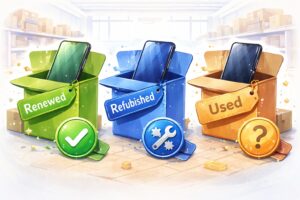
Renewed usually means the item was checked, tested, and cleaned, then sold again with some kind of guarantee.
Refurbished usually means the item had a problem or was returned, got repaired or rebuilt, then tested and sold again.
Used usually means someone had it before and now it’s being sold as is, with a condition grade.
Now let’s go deeper.
What does Amazon Renewed mean?
Amazon Renewed is a program, not just a random word. Items listed as Renewed are supposed to be inspected and tested to work like new. They are often cleaned, reset, and repackaged. They may come with generic accessories instead of original ones.
You will often see Renewed on phones, laptops, tablets, headphones, smartwatches, and small electronics.
What you can expect:
- Works properly in most cases
- May have small cosmetic marks
- Packaging may not be original
- Accessories may be third-party
- Some type of guarantee is usually included
When Renewed is a good idea:
- You want a discount but still want a safety net
- You care more about function than perfect packaging
- You are okay with a tiny scratch if the price is right
What I always check:
- Who the seller is
- What the warranty or return policy says
- The condition notes, not just the label
What does Refurbished mean?
Refurbished is a broader term and can be messy because it depends on who did the refurbishing.
Sometimes refurbished means professionally repaired, tested, and restored. Other times it means, “We wiped it and it turns on.”
Refurbished can include things like:
- A phone with a replaced battery
- A laptop with a replaced keyboard
- A device repaired after a defect
- A unit used for display, then cleaned up
Refurbished can be great value, but it has more variation than Renewed.
When refurbished is a good idea:
- The refurbisher is the manufacturer or a well-known certified partner
- The listing clearly states what was replaced or tested
- The warranty is solid
When refurbished is risky:
- The seller is unknown
- The description is vague
- The warranty is weak or unclear
If you want to buy refurbished, treat it like buying a used car. You want proof it was checked properly.
What does Used mean on Amazon?
Used is the simplest label. It just means it has had a previous owner. The item is sold with a condition grade like:
- Like New
- Very Good
- Good
- Acceptable
Used is common for books, furniture, and open-box items. It can also show up in electronics, but electronics used purchases depend heavily on the seller and the condition notes.
Used can be an amazing deal, but it has the biggest range.
What you can expect:
- Condition depends on the previous owner
- May have missing accessories
- May have cosmetic wear
- Performance can be hit or miss for electronics
Used is a good idea when:
- You are buying something low risk, like a book, a stand, a basic accessory
- You can accept scratches or signs of wear
- The price difference is worth it
Used is risky when:
- You are buying batteries, chargers, storage devices, or expensive electronics
- You need guaranteed performance
- You hate dealing with returns
Quick comparison: which one is safest?
If you want the safest choice, usually it goes like this:
Renewed is the safest of the three for electronics.
Refurbished can be safe if it is done by the right seller.
Used is safest for simple items and most risky for high-tech stuff.
That’s the general pattern. The listing details can still change everything.
The 7 checks I do before buying any of these
- Check who sells it and who ships it
If it ships from Amazon or is fulfilled by Amazon, returns are usually easier. - Read the condition notes
Do not rely on the label alone. Look for details like scratches, dents, missing parts. - Check what is included
Many renewed or used items come without original cable, case, or charger. That can kill the deal. - Look for warranty and return policy
Even a short warranty is better than none. If returns are complicated, skip it. - Read recent reviews for the seller
Not just the product. The seller matters a lot when you buy renewed or used. - For phones and laptops, check battery expectations
A used phone with a tired battery can feel like a scam. If battery condition is not mentioned, be cautious. - Compare the price difference
If new is only 10 percent more, I usually go new. If it’s 30 to 40 percent less, then renewed or refurbished starts to make sense.
What I would buy in each category
I would happily buy renewed:
- headphones
- smartwatches
- tablets
- laptops from reliable sellers
- phones if the return policy is strong
I would consider refurbished:
- laptops and phones only if the refurbisher is trustworthy and warranty is clear
- big-ticket items where the savings are meaningful
I would buy used:
- books
- desk accessories
- non-electronic items
- simple gear where scratches do not matter
I avoid used for:
- power banks
- batteries
- storage drives
- anything that can be damaged internally without visible signs
Final takeaway
Renewed, refurbished, and used are not the same. Renewed is usually the safest discount option because it is tied to a program and typically comes with a guarantee. Refurbished can be the best value, but only if the refurbisher is legit and the warranty is clear. Used can be a steal, but it’s the most unpredictable, especially for electronics.
If you want to save money without regret, your best move is simple: read the condition notes, check the seller, confirm what’s included, and make sure returns are easy.